
By Martin Waters, director, field automation, Nextpower
This article was originally published in the 2026 kWh Analytics Solar Risk Assessment. Read the full 2026 Solar Risk Assessment here.
The industry recognizes PV connectors as a common point of failure, but we are only beginning to understand how pervasive the risk of fire is within the DC balance of system (BoS)— and how invisible these threats are using traditional inspection methods. Thermal inspection of DC BoS is widely used as an early detection method to identify failure precursors that manifest as heat, such as elevated resistance and poor electrical contact. However, analysis of over 2 gigawatts of utility-scale inspections conducted using ground-based robotics reveals a critical detection gap: 79% of identified high-risk PV connector and fuse issues exhibited no detectable thermal anomaly at the time of inspection. (Fig. 1)
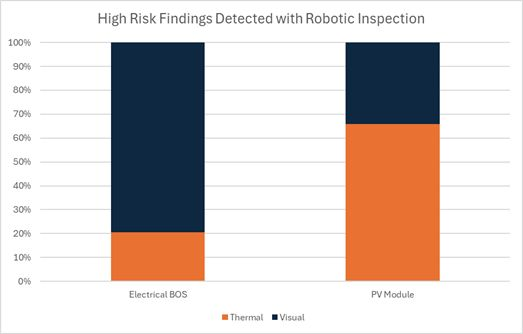
Figure 1: High Risk Findings Detected with Robotic Inspection This finding is nearly the inverse of module-level issues where 66% have thermal signatures. So, while a visual inspection is important for modules, it is critical for connectors.
This finding is especially significant given that wildfire is the second-largest loss driver on utility-scale solar projects in North America by gross claims, according to Axis Capital. Further, kWh Analytics finds that over 80 percent of fires originate on site, with PV equipment serving as the primary source of ignition. Wiring or connectors have been identified as the cause of the fire in 3 percent of those cases, but an additional 27 percent are still attributed to unknown causes.
Given that most high-risk connector failures begin without measurable heat, high-resolution visual inspection must complement thermography to meaningfully reduce ignition frequency. Unfortunately, the DC BoS also presents visibility challenges. Components are frequently concealed behind modules, under wireways, or obstructed by structural members—reducing the effectiveness of both manual field walks and aerial drone thermography.

Figure 2: Cracked connector end caps
Research shows the efficacy of ground-based robots equipped with optical zoom and thermal sensors for this task. The high-resolution visual inspections enabled peer-to-peer component comparison under identical ambient conditions and uncovered non-thermal failure precursors, including connector cracking, insulation shrink-back, improper mating, fuse assembly defects, and partial disconnections. Many of these conditions precede thermal escalation and represent intervention points before heat signatures emerge.
More on NX Ranger

Manual inspections miss issues and slow response times. NX Ranger uses autonomous robotics and AI-driven imaging to detect defects early, improve QA/QC accuracy, and deliver real-time insights that protect performance and reduce operational risk. Learn more.